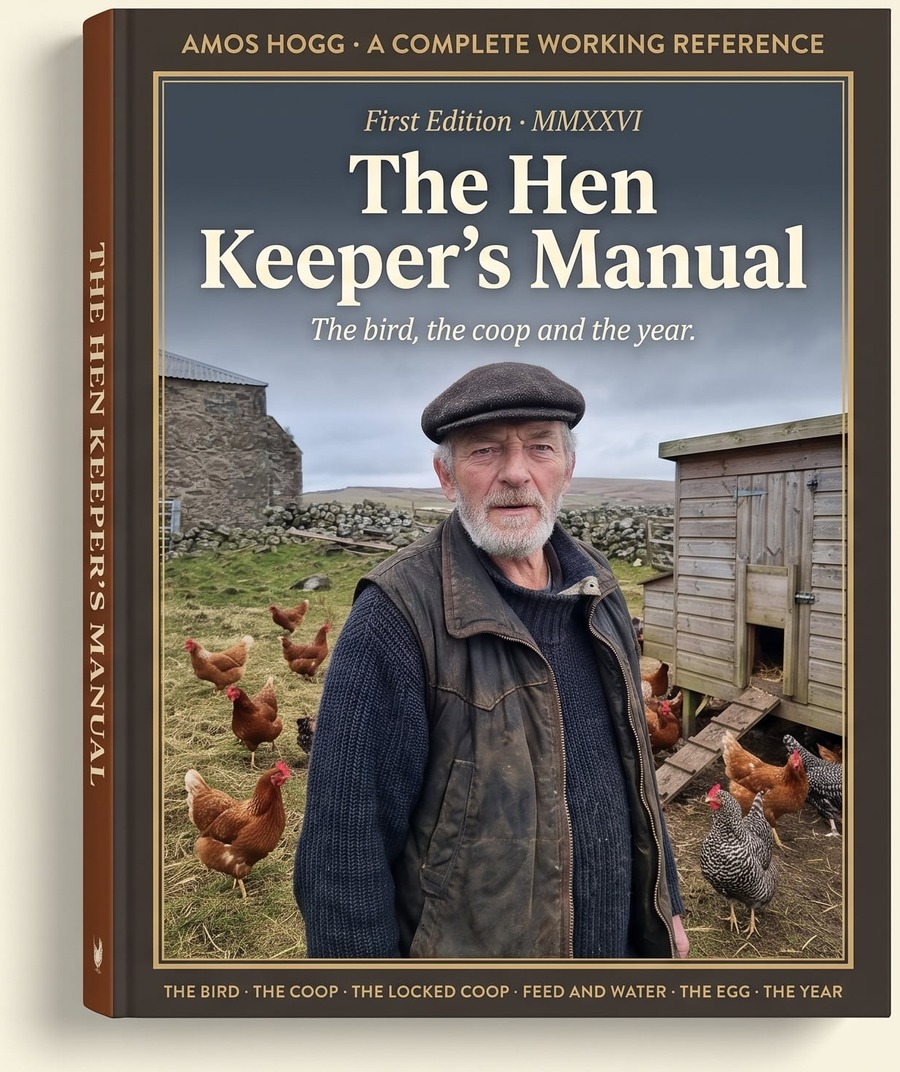
Amos Hogg The Hen Keeper's Manual
Launch promo ends in 00:00:00
Amos Hogg · North country hill farm

Keeping hens is easy. Keeping them alive is the part nobody teaches you.

One hundred and forty-eight pages of method, not charm — the bird, the coop, the lock on the door, the feed, the egg, and the twelve months of the year. Every method run on real birds on real ground, and where a method costs money, the cost is on the page.

Instant download · Yours forever

148Pages
20Chapters
100Checks
Amos Hogg on his hill farm

“I did not set out to teach anybody. I set out to keep hens alive, because for four years I was not very good at it.”

Amos Hogg · Front matter
The Hen Keeper's Manual, First Edition
Section I · The Manual

A hundred and thirty years of one family finding out what works.

My great-grandfather came over from the Scottish Borders with a wife, a trunk, and a way of doing things. What he wrote down, my grandfather Angus kept in a hardback ledger in the milk room. When people on the channel say the old Scottish farmer's method, that ledger is what they are talking about.

It is a hundred and thirty years of one family keeping birds alive in a cold place with no money to waste. This manual is that ledger, opened up, tested again, and written out plainly — chapter by chapter, the way one person walks another through a job at their elbow.

“There is not one page in here I would not stand over in my own barn.” Amos Hogg · Before You Begin

I lost birds to a fox in daylight. I lost a whole run of pullets to a weasel, through a gap I would have sworn a mouse could not use. I had twenty-two hens go off lay one November and stood in that coop convinced they were sick, when in fact nobody had ever told me what a molt looks like. Every one of those was avoidable. Every one of them is in this book, because I would rather you learn it here than the way I learned it.

✦ ✦ ✦
Section II · The Difference

Most keepers are not short of advice. They are short of a method.

There is no shortage of people online who will tell you what to do with your birds. Very few of them keep birds on your ground, in your climate, and almost none of them will tell you what it costs.

How most people learn it
How the ledger does it
Advice from six strangers on a forum, none of whom keep birds in your climate — and all six disagree.
One family's method, run on one cold hill for a hundred and thirty years, and corrected where it failed.
A video tells you what to do. It almost never tells you what it costs.
Where a method costs money, the cost is on the page — 2026 US dollars, farm-store prices, not the cheapest thing findable online.
You find the gap in the fence the morning after you have lost the bird.
Two fingers through it and a weasel gets through it. A fist and a raccoon does. Chapters 8–10 close both, for good.
Nobody warns you about the November your hens simply stop laying, so you assume disease.
Chapter 14 is why hens stop, what a molt actually looks like, and how to start them again.
Everything sounds equally urgent, so you change four things at once and never learn which one worked.
Fix the one trouble that is bothering you most, properly, then watch the birds a week. It says so in the front of the book.
No record kept, so you cannot tell a veterinarian what changed, or when it started.
The Flock Records — a date, a bird, a number, a word. Two minutes a week, and it has saved me more than once.

✦ ✦ ✦
Section III · What's Inside

Twenty chapters, eight parts, and a hundred checks at the back.

Every chapter is built the same way. It opens with the trouble, plainly stated. It works through the method. Then it says what the method does not do, where it fails, and when the answer is a veterinarian instead of a book.

First Thingsp. 9
  • The First Week. The seven days that decide whether a flock thrives — and the three mistakes that cost beginners the most birds.
Part I · The Birdp. 14
  1. 01What A Hen Actually Is
  2. 02Choosing The Right Breed For Your Ground
  3. 03Buying Birds Without Getting Cheated
  4. 04Reading A Hen At Twenty Paces
Part II · The Coopp. 37
  1. 05Where The Coop Goes
  2. 06Air, Roosts, Nests And Floor
  3. 07The Run, The Fence, And Free Ranging
Part III · The Locked Coopp. 54
  1. 08Every Animal That Takes Hens
  2. 09Reading The Morning Evidence
  3. 10Hardening The Coop For Good
Part IV · Feed And Waterp. 73
  1. 11What A Hen Actually Eats
  2. 12Water, And The Way It Kills A Flock
Part V · The Eggp. 85
  1. 13How A Hen Makes An Egg
  2. 14Why Hens Stop Laying, And How To Start Them Again
  3. 15Gathering, Cleaning And Keeping Eggs
Part VI · Healthp. 104
  1. 16Mites, Lice, Worms And Scaly Leg
  2. 17The Sick Hen: A Symptom-First Guide
  3. 18Quarantine, Culling And Keeping Trouble Out
Part VII · The Yearp. 124
  1. 19Chicks: From The Box To The First Egg
  2. 20The Keeper's Year, Month By Month
Appendixp. 137
  • The Keeper's Hundred. One hundred numbered checks, drawn out of the twenty chapters and set down in order — the book condensed to what I would actually say to somebody standing in their own yard.
  • The Flock Records. My grandfather's ledger sheets, ready to print and keep.
Get the Hen Keeper's Manual — $47 $27

Instant download · Yours forever

✦ ✦ ✦
Section IV · Reader Results

What keepers write in through the channel.

The next edition gets corrected by these. If something in the book does not work on your ground, I want to hear it.

★★★★★

“I went round my run at dusk with a flashlight the way Chapter 10 says, from the outside in. Found four places light came through. I had been keeping birds two years and had never once looked at it that way.”

— Placeholder reader, Vermont
★★★★★

“Nine of mine quit laying in October and I was ready to call a vet. It was a molt, exactly as described on page 92. Saved myself the call and the worry, and they were back in February.”

— Placeholder reader, Missouri
★★★★★

“The bit about air was the whole thing for me. My coop was snug and I was proud of it. Opened the top vents as the book says and the damp smell was gone in a week.”

— Placeholder reader, Upstate New York
Amos Hogg
Section V · About

Amos Hogg

I keep hens on a hill farm in the north country, on ground my family has worked since my great-grandfather came over from the Scottish Borders. Some of what is in this manual has been on the channel. Most of it goes further than the channel does, because a book has room that a video does not.

I am not a veterinarian, and this manual is not veterinary advice. What I can do — what the old ledger did — is teach you to observe well enough to know when a bird needs professional attention and when she needs nothing but time. Where a chapter reaches the edge of what a keeper should do alone, it stops and says so.

The money is not the reason to keep hens. A backyard egg costs more to produce than a supermarket one, near enough always, once you count the feed and the coop and your Saturday. Anyone selling you on the savings is selling you something. The reason to do it is that you know exactly what went into the bird and exactly what came out of her.

Amos HoggNorth country · 2026
✦ ✦ ✦
Section VI · The Order

The Hen Keeper's Manual

First Edition · A complete working reference to the bird, the coop and the year.

Everything in the ledger, in one file.

Instant download. Read it on the phone in the coop doorway, or print it and keep it in the barn.

  • The Hen Keeper's Manual, First Edition — 148 pages, illustrated, PDF
  • 20 chapters across eight parts — the bird, the coop, the locked coop, feed and water, the egg, health, and the year
  • The First Week — the three mistakes that cost beginners the most birds
  • The Keeper's Hundred — 100 numbered checks, the whole book condensed
  • The Flock Records — my grandfather's ledger sheets, ready to print
  • Real costs on every method — 2026 US dollars, farm-store prices
$47 $27
Get the Hen Keeper's Manual — $47 $27

Instant download · Yours forever

Card · PayPal · Apple Pay · Google Pay

✦ ✦ ✦
Section VII · Questions

Straight answers.

Is this just the channel, printed out?

No. Some of what is in here has been on the channel, and where it has, the book goes further — because a book has room that a video does not. The chapters that have never been on the channel are most of Part III, most of Part VI, and the whole of the Appendix.

Your videos are free. Why buy the manual?

Because a video is watched once and a manual is opened on the morning something is wrong. The book is ordered the way the trouble arrives — you can go to the page instead of scrubbing through an hour of footage trying to remember which video had the bit about the water.

And because the hundred checks at the back do not exist anywhere else. That is the book condensed to what I would say to you standing in your own yard.

Why only $27?

Because I would rather it was in the hands of the person with six hens and a half-built coop than sat behind a price they will think about for a fortnight. It is priced at roughly one bag of layer feed. If it stops you losing one bird it has paid for itself several times over.

What format is it, and do I get a printed copy?

It is a 148-page illustrated PDF — a digital edition, not a physical book. It downloads the moment you order and reads on a phone, tablet, or computer. Many keepers print the Appendix and leave the sheets in the coop; the pages are laid out to print cleanly on ordinary letter paper.

I keep six hens in a town garden, not on a hill farm. Does it apply?

It is written for exactly that flock. Six to eight birds is the number I steer people toward and the number I would choose again. Where the book has a hill-farm answer and a small-garden answer, it gives both — including the chapter on siting a coop close enough to the house that you will actually walk out to it in February.

Is any of this veterinary advice?

None of it. I am not a veterinarian and the manual says so on its second page. Poultry medicine is a real field with real licensure, and there are things in a sick bird that no book can see. Where a bird is unwell or injured, or fails the checks in these pages, the book tells you to ring a licensed veterinarian — and it tells you what to have ready when you do.

Amos Hogg
Wait — one thing

Less than one bag of feed.

That is what the whole ledger costs you today — a hundred and thirty years of keeping birds alive in a cold place, for less than a sack of layer pellets. The promo price ends at midnight.

Get the Hen Keeper's Manual — $47 $27

Instant download · Yours forever

or see what's inside →